
Who we are
SaveTonnes is a Home & Business Energy Upgrades Marketplace in South East Queensland. One enquiry brings up to three quotes from local installers.
We also run neighbourhood programmes, one postcode at a time. Our first is SaveTonnes 4218.
We do not install, and we are not owned by anyone who does.
Our mission
Help South East Queensland homes go electric in the right order, with a clear plan first and local installers to deliver it.
Our vision
Every street in South East Queensland able to upgrade together, with fair prices, local installers, and results we publish.
What we do, end to end
A programme runs education first, then registration, then installation, then reporting. Each step below carries its honest status in brackets.
- Educate. Free sessions in the community before anyone gets a quote. [Planned for 4218]
- Register. Neighbours put their hand up by postcode, so local demand is visible in one place. [Planned for 4218]
- Source installers. Installers provide a licence and accreditation number before they can take a job. [Rule in place. No jobs have been allocated yet]
- Plan the volume. We tell suppliers, manufacturers and installers what a street intends to do, so they can plan, buy and crew for it. [Intent. No pricing has been secured yet]
- Administer and report. Aggregated results go to sponsors and partners, never a household's record, on a stated method. [Method not yet agreed]
Our point of difference
When more homes on one street upgrade in one cohort, installers can plan, buy and crew efficiently, which lets a saving pass to the household.
The advantage is meant to come from volume and planning, not from additional subsidies. We have not run a cohort yet, so this is our intent, not a result.
Impact, honestly stated
What we can show today is our founder's record.
In May 2009, Ecovation partnered with Logan City Council on a street by street solar hot water programme.
On 26 November 2009, Ecovation was named in Queensland Parliament as one of two companies contracted under the state scheme (Hansard).
By August 2010, more than 400 homes had taken part (Tweed Echo, 26 August 2010).
Our values
Fair. Jobs go by rotation, and nobody can buy a place at the front of the queue. [Beta rule]
Independent. We do not install, and we are not owned by anyone who does.
Plain. We say what we do, what we do not do, and what is not yet proven.
Local. Built in South East Queensland, for South East Queensland.
Accountable. Every figure we publish shows its method, its source and its date.
Our fair go charter
This is the beta charter for SaveTonnes 4218. It is published by Total Results Marketing Pty Ltd, trading as SaveTonnes, ABN 12 087 309 304, and it may change before the programme runs.
- We do not install, and we are not owned by anyone who does.
- Installers provide a licence and accreditation number before they can take a job: SAA accreditation for solar and battery, a Queensland electrical contractor licence, and ARCtick for refrigerant work.
- Up to three installers quote on a residential job, and two on a commercial job.
- Jobs are allocated by rotation across eligible installers. Nobody can buy a place at the front of the queue. [Beta rule]
- Nobody representing a programme sells at a community event.
- Sponsors and partners receive aggregated reporting only, never a household's record.
- Every programme runs education first, then registration, then installation, then reporting.
The founder
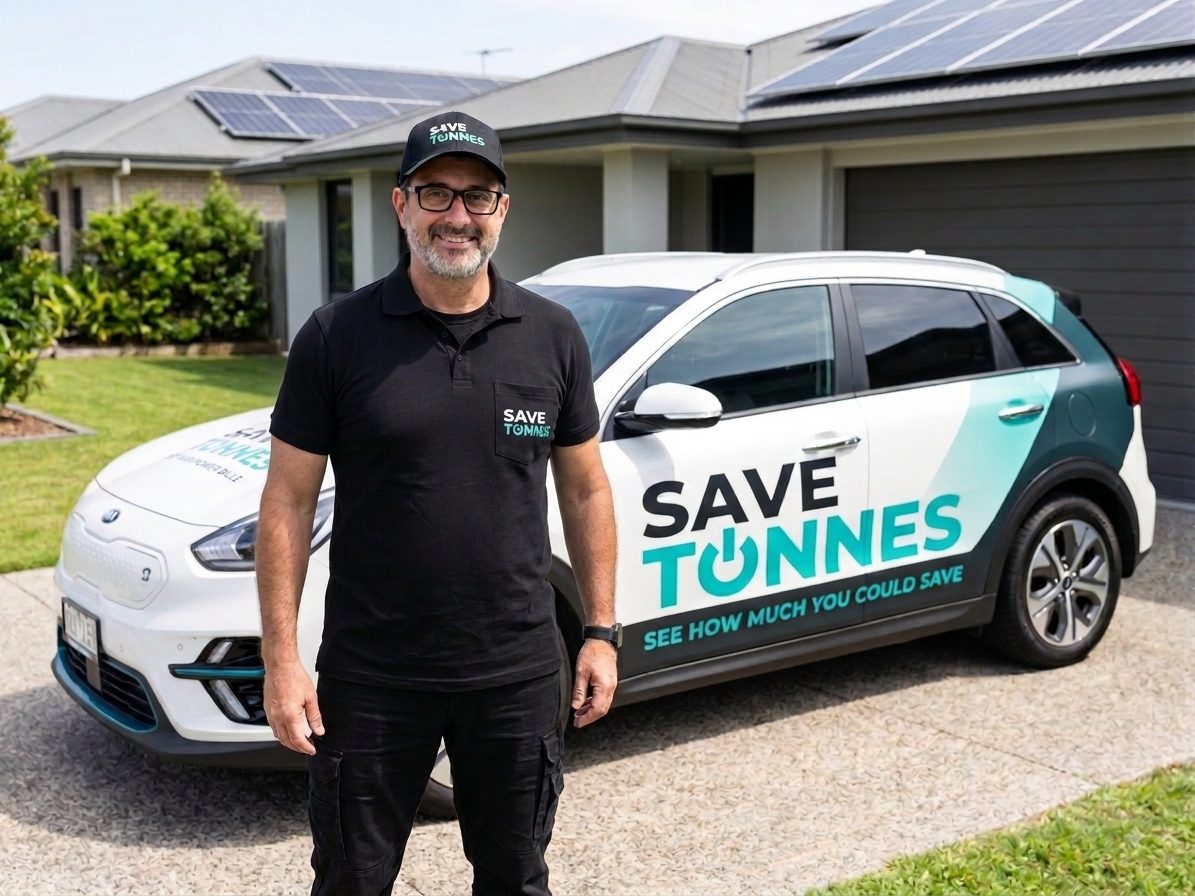
In May 2009, Dewayne Montey's company, Ecovation, partnered with Logan City Council on the Solar Neighbourhoods Program. The brief was to move homes off electric hot water, on a budget no hot water manufacturer could make work.
They were solving the wrong problem. They were trying to bring the price of the product down. The cost was never the unit. It was labour, logistics and finding customers, all inflated by treating every home as a separate job. So Ecovation changed the method: street wide, suburb deep. Convert a street at once and crews stop driving between suburbs, deliveries consolidate, and one mobilisation covers dozens of installs.
Then came the part nobody budgets for. Ecovation taught people first, at forums in local libraries and community centres, co-funded with council. Neighbours who had already said yes did the persuading.
The programme was a finalist in the 2009 Keep Australia Beautiful Awards, Energy Warriors category. On 26 November 2009, Hansard recorded Ecovation as the second company contracted to supply, deliver and install solar hot water under the state scheme. The industry had called that price impossible.
It ended, and not because the method failed. Federal funding was withdrawn after the Home Insulation Program collapsed, and the Renewable Energy Certificates the business relied on sat untradeable for more than a year. The business did not survive it.
Since then Dewayne has worked both sides of the supply chain: wholesale, residential, and commercial and industrial. He has watched the same cycle repeat. A rebate lands, installers gear up, the rebate winds back, and the work disappears. In May 2026, household battery installations fell by more than 70 per cent after the federal home battery rebate was scaled back on larger systems (Clean Energy Regulator data, reported by ABC News, 18 July 2026). The industry calls it the solar coaster and treats it as weather. It is not weather. It is what happens when demand comes from a subsidy rather than from planning and education.
SaveTonnes is the same method, with the technology and the demand finally caught up: education first, neighbours putting their hands up together, and installers given enough work in one place to plan for. One postcode at a time, starting with his own, 4218.
The flywheel
More households in one place lets installers plan, buy and crew efficiently, which is how a saving can pass to the household. Work that is planned brings more local installers in. More installers mean more capacity and shorter waits. Good work turns neighbours into advocates, and advocates bring the next street. None of this has turned yet. SaveTonnes 4218 is where it starts.
Partners in a neighbourhood programme
Four seats, one programme
A SaveTonnes programme runs in one postcode at a time. Beside the installers who do the work, it has four partner seats: councils and public bodies, community groups and member organisations, sponsors, and manufacturers and suppliers.
SaveTonnes sits in none of those seats. We run the programme: education first, then registration, then installation, then reporting. We do not install, and we are not owned by anyone who does.
Councils and public bodies
We do not ask a council to endorse any installer.
What a council gets is a programme run by an operator that does not install and is not owned by anyone who does. Jobs are allocated by rotation across eligible installers, and nobody can buy a place at the front of the queue. That is a beta rule, and we say so.
The reporting standard is the same for every seat. We report counts of enquiries, jobs won and jobs completed, aggregated by postcode. Every figure shows its method, its source and its date. Councils, sponsors and partners receive aggregated reporting only, never a household's record.
The ask is one conversation about one pilot in one postcode. Not a programme across your whole area off a first meeting. If the first pilot is reported, the next postcode is a separate decision.
We will name partners only once an agreement is signed.
Community groups and member organisations
Bring a programme to your area. A sports club, a residents' association, a school community or a member organisation can be the anchor for a programme in its own postcode.
What we need from you: a postcode, a venue for an education session, and someone who can bring neighbours into the room. Nothing else to begin with.
What you get: education sessions before anyone is asked for a quote, a registration page for your area so local demand is visible in one place, licensed local installers allocated by rotation, and a report at the end that shows what happened. Nobody representing the programme sells at a community event.
This is a route we are building, not a network that already exists. SaveTonnes 4218 is the first programme.
We will name partners only once an agreement is signed.
Sponsors
A sponsor funds the programme: the education sessions, the registration drive, the administration and the reporting for one postcode.
A sponsor never buys three things. Allocation: jobs go to installers by rotation under a beta rule, and nobody can buy a place at the front of the queue. Household data: sponsors receive aggregated reporting only, never a household's record. Endorsement: a sponsor does not endorse any installer, and no installer is presented as a sponsor's pick.
What a sponsor receives is the sponsor report. It records enquiries, jobs won and jobs completed in the postcode the sponsor funded, with the method, source and date of every figure.
We will name partners only once an agreement is signed.
Manufacturers and suppliers
This is the supply seat. A programme concentrates volume in one postcode, so installers can plan, buy and crew efficiently, which lets the saving pass to the household.
The supply seat is for product and technical support to the installers delivering a programme. No supply partner is in place today. Supply partners do not choose installers and do not see household data. The same rotation and the same reporting apply.
Reference deployments come only after a pilot is reported. Until then, what we offer is a conversation about the SaveTonnes 4218 programme and what a supply partner would need to be ready for it. We have not agreed a supply arrangement with anyone, and we do not claim one.
We will name partners only once an agreement is signed.
Register your interest
One form serves every seat. Register your interest, put your organisation in the business name field and state your role in the position field: council or public body, community group, sponsor, or manufacturer and supplier. We will come back to you to arrange one conversation.
Who to talk to
- Households. Start with a clear plan for your home. Get your plan.
- Businesses. Commercial solar, Energy storage, Fleet EV, Energy audits. See business options.
- Installers. Join the founding installer waitlist.
- Councils and community groups. Register your interest through the installer waitlist form and tell us your role.
- Sponsors. Register your interest through the installer waitlist form and tell us your role.
- Manufacturers and suppliers. Register your interest through the installer waitlist form and tell us your role.
Where we are today
SaveTonnes 4218 is our first programme. It is not yet running, and we have not completed any installs. Figures we publish will show their method, source and date.
SaveTonnes 4218 is Queensland's first neighbourhood energy upgrades pilot funded through strategic business partnerships.